
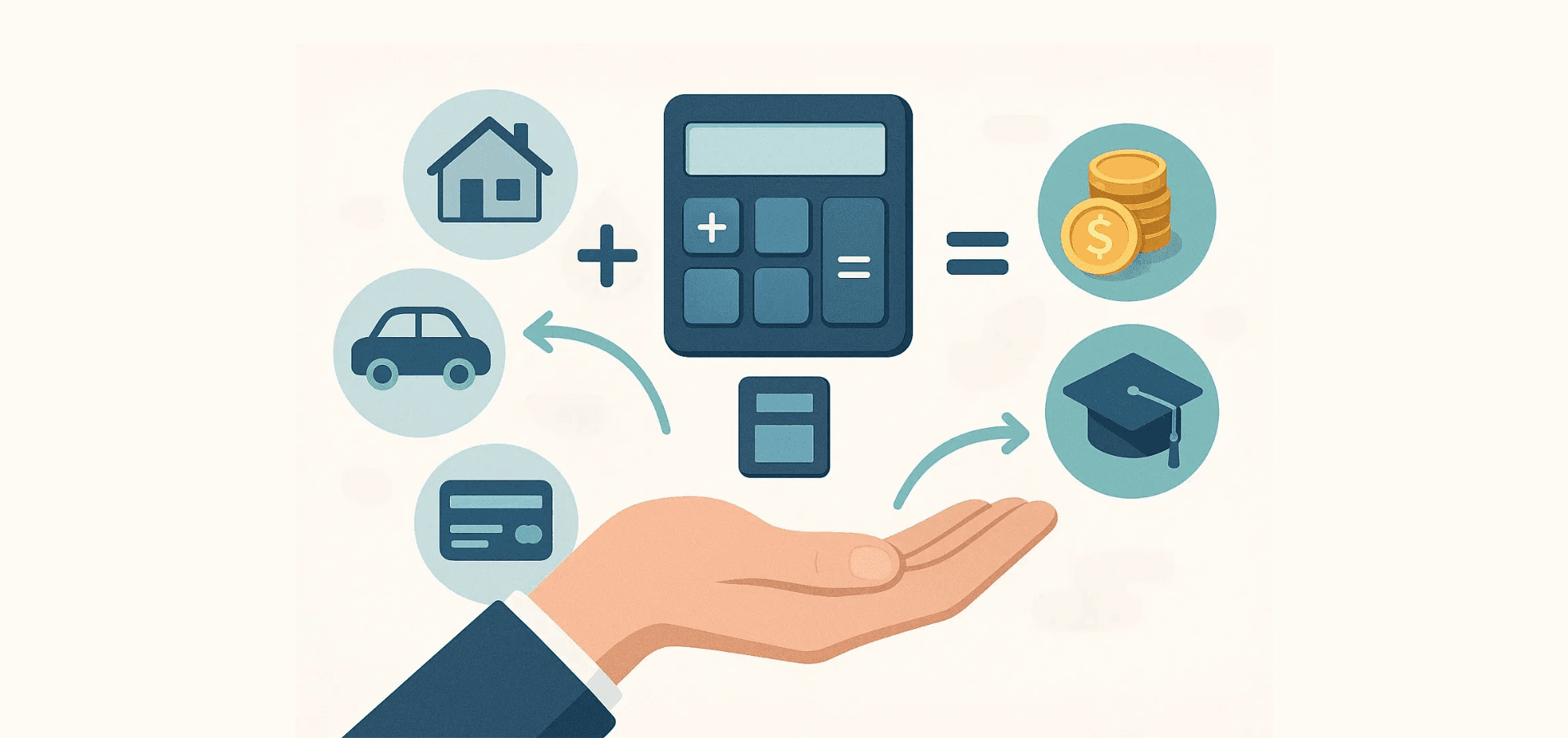
If you’re thinking about refinancing, your debt-to-income ratio (DTI) is one of the most important numbers lenders will review. It tells them how much of your monthly income is already committed to debt — and how comfortably you can handle a new mortgage payment.
The good news? Calculating your DTI is simple once you know what lenders include, what they ignore, and how to avoid mistakes that can push your ratio higher than it actually is.
This guide walks you through how to calculate your DTI for refinancing, the difference between front-end and back-end DTI, what counts as “debt,” and what a good DTI looks like for different loan programs.
Key Takeaways
✅ DTI measures how much of your income goes toward debt payments each month
✅ To calculate DTI: add all monthly debt payments and divide by gross monthly income
✅ Mortgage, car loans, student loans, and credit cards all count toward DTI
✅ Most refinance approvals require a DTI of 45% or lower, depending on loan type
💡Pro Tip: Most borrowers never compare Loan Estimates, even though small improvements in rates and fees can affect your DTI, monthly payment, and long-term savings. To ensure you have a competitive offer, upload your Loan Estimate to Fincast to see if vetted lenders can offer you a better rate. There are no extra credit pulls or spam.
What Is DTI?
Your debt-to-income ratio (DTI) compares your monthly debt obligations to your monthly gross income (income before taxes).
It’s one of the primary indicators lenders use to measure whether you can safely afford a mortgage — and how much they’re willing to approve you for.
There are two types of DTI lenders to look at:
1️⃣ Front-End DTI (Housing-Only Ratio)
This measures only your housing costs:
Mortgage principal
Mortgage interest
Property taxes
Homeowners insurance
Mortgage insurance (if applicable)
HOA dues (if applicable)
2️⃣ Back-End DTI (Total Debt Ratio)
This is the DTI that matters most during refinancing. It includes all monthly minimum debt payments:
Mortgage (PITI + HOA)
Auto loans
Credit card minimum payments
Student loans
Personal loans
Child support or alimony
Installment loans
💡 Pro Tip: Only the minimum required payment counts — not any extra amount you pay.
How to Calculate Your DTI (Step-By-Step)
Calculating your DTI takes a few simple steps.
Step 1: Add Up All Monthly Debt Payments
Gather all the debts lenders include in your back-end DTI:
✔ Mortgage (PITI):
Principal
Interest
Property taxes
Homeowners insurance
Mortgage insurance (PMI/MIP)
HOA fees (if any)
✔ Auto loans
Use your monthly payment shown on the statement.
✔ Credit cards
Use the minimum payment listed — even if you normally pay more.
✔ Student loans
Lenders use:
Your actual monthly payment, OR
A percentage of your balance if your loans are in deferment
✔ Personal loans & installment loans
Use the fixed monthly payment.
✔ Legal obligations
Child support or alimony must be included if ordered by the court.
What NOT to include:
❌ Utilities
❌ Cell phone bills
❌ Groceries
❌ Gas
❌ Insurance premiums (other than homeowners)
❌ Subscriptions
❌ Day-to-day living expenses
Lenders may also include debts that don’t show on a credit report if they’re court-ordered or documented.
Step 2: Calculate Your Gross Monthly Income
Use income before taxes — not take-home pay.
Lenders include:
Salary or hourly wages
Overtime (if 24-month history)
Bonuses or commissions (24-month history)
Self-employment income
Rental income
Pension or retirement income
Social Security
VA disability income
Alimony or child support (if chosen to be counted)
💡 Pro Tip: If your income varies seasonally or includes bonuses, lenders use a 2-year average.
Step 3: Calculate your Front-End (Housing Only) DTI
Use the standard lender formula:
DTI = Monthly Housing Payments ÷ Gross Monthly Income
Example Calculation
Monthly housing payment: $1,500
Gross monthly income: $6,000
DTI = 1,500 ÷ 6,000 = 25%
Your front-end DTI is 25%.
Lenders use this number to determine how much loan you can afford.
Step 4: Calculate your Back-End (Total Debt) DTI
Many lenders focus on your total DTI to get the big picture of your monthly finances. To do this, use the following equation:
DTI = Total Monthly Debt Payments ÷ Gross Monthly Income
Example Calculation
Total monthly debts: $2,400
Gross monthly income: $6,000
DTI = 2,400 ÷ 6,000 = 40%
Your DTI is 40%.
This is a strong range for refinance approval.
What DTI Do You Need to Refinance?
Each loan program has different DTI limits, but individual lenders can have their own overlays in addition to these minimum requirements:
Loan Type | Max DTI by Program | Notes |
Conventional | 36% - 45% | Some lenders allow up to 50% with strong compensating factors |
FHA | 31% - 43% | Some lenders allow higher DTIs with automated underwriting |
VA | No strict limit | Approvals based on residual income |
USDA | 41% | Slight flexibility with compensating factors |
Streamline Refinance (FHA/VA) | Many lenders do not do a DTI review | Simplified approval for many lenders, although some may still calculate the DTI |
💡 Pro Tip: Even if your DTI is above program limits, refinancing may still be possible if the new payment reduces your monthly debt load.
How to Know If Your DTI Is “Good” for Refinancing
Here’s how lenders typically view DTI ranges:
DTI Range | How Lenders See It |
≤ 36% | Excellent — may offer best pricing & easiest approval |
36–43% | Strong — within comfortable limits |
43–45% | Acceptable for some lenders |
45–50% | Borderline — FHA/VA may approve, varies by lender |
> 50% | High — conventional unlikely, FHA/VA possible with some lenders |
If your DTI is 40% or below, you may be in a strong position to refinance.
How to Lower Your DTI Quickly
If your DTI is slightly high, here are ways to reduce it before applying:
1️⃣ Pay down revolving debt (credit cards)
Lowering minimum payments has the biggest impact.
2️⃣ Avoid taking out new loans
A new auto loan or line of credit can raise your DTI overnight.
3️⃣ Increase your income (in lender-approved ways)
Raises, promotions, or adding a co-borrower with good income and little debt can help.
4️⃣ Refinance into a lower payment
A refinance that reduces your mortgage payment can also lower your DTI.
5️⃣ Consolidate high-interest debt (carefully)
In some cases, consolidation reduces your total minimum payments — improving DTI.
Common Mistakes When Calculating DTI
Avoid these errors to get an accurate number:
❌ Counting expenses that don’t qualify (utilities, groceries, phone bill)
❌ Using net (take-home) income instead of gross income
❌ Forgetting minimum payments on credit cards
❌ Ignoring deferred or income-based student loans
❌ Forgetting HOA dues (these always count)
❌ Not including alimony/child support when court-ordered
💡 Pro Tip: When in doubt about a specific payment, assume lenders will include it.
How Fincast Helps You Use Your DTI to Get Competitive Refinance Terms
Your DTI is a powerful tool — but lenders interpret it differently. One lender may deny a 45% DTI, while another may approve it easily with better pricing.
Fincast gives you transparency and leverage.
How it works:
Get a Loan Estimate from any lender
Upload it securely to Fincast
Vetted lenders compete privately to beat your rate or fees
You choose the best offer — no extra credit pulls
A more competitive rate may reduce your monthly payment — and potentially lower your DTI even further.
FAQs
1. What’s the difference between front-end and back-end DTI?
Front-end includes only housing expenses; back-end includes all debts and is the main number lenders use.
2. Do utilities count toward DTI?
No — only debts with monthly minimum payments are included.
3. How do student loans affect DTI?
Lenders use your reported payment or a percentage of the balance if the loan is deferred.
4. Do streamlines require DTI calculations?
FHA Streamline and VA IRRRL may not require income or DTI verification, but it varies by lender.
5. What is a good DTI for refinancing?
Below 43% is ideal, but FHA and VA programs allow higher limits, in some cases.
Bottom Line
Calculating your DTI is one of the simplest ways to understand your refinance options — and how lenders will view your application. You’re in a strong position when your DTI is clear, accurate, and backed by stable income and on-time payment history.
A refinance may lower your monthly payment, improve your loan terms, or boost long-term savings. Upload your Loan Estimate to Fincast to see whether vetted lenders can offer better terms and help you move forward with confidence.
Disclaimer: Nothing in this content should be considered financial advice. The examples and data shared are for general information only and may not reflect your personal situation. We do not guarantee the accuracy or completeness of the information provided. Always do your own research and speak with a qualified financial advisor before making any financial decisions.
Ready to Save On Your New Mortgage?